Reassessing the Gold Standard
The Role of AI-Powered Urinalysis in Diagnosing Urinary Tract Infections
DOI:
https://doi.org/10.21141/PJP.2026.595Keywords:
artificial intelligence, urinalysis, urinary tract infection, machine learning, deep learning, diagnostic accuracyAbstract
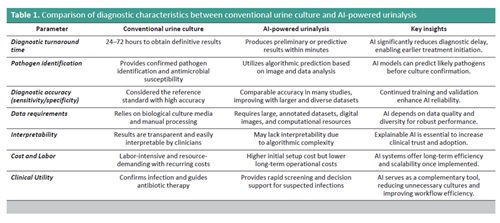
Urinary tract infections (UTIs) are among the most common bacterial infections worldwide, requiring timely and accurate diagnosis to guide appropriate therapy and reduce antimicrobial resistance. Although urine culture remains the diagnostic gold standard, its prolonged turnaround time and susceptibility to pre-analytical variability limit its clinical efficiency. Recent advances in artificial intelligence (AI) have positioned urinalysis as a promising alternative diagnostic approach, utilizing machine learning and deep learning algorithms for automated analysis and prediction. This review synthesizes current evidence on AI applications in urinalysis for UTI diagnosis, examining computational techniques, diagnostic performance, clinical integration, limitations, and future directions. The literature demonstrates that AI-powered urinalysis can achieve diagnostic accuracy comparable to urine culture, with high sensitivity and specificity while reducing diagnostic time. Integration of AI into clinical workflows has the potential to enhance decision-making, streamline laboratory processes, and support antimicrobial stewardship. However, challenges related to data heterogeneity, algorithm interpretability, validation, and regulatory requirements remain significant barriers to widespread adoption. Overall, AI-driven urinalysis represents a transformative opportunity to complement the existing diagnostic standard and advance more rapid, efficient, and personalized approaches to UTI management.
Downloads
References
Althowaimer MA, et al. Urinary tract infections (UTIs): laboratory diagnosis—the role of artificial intelligence and smart diagnosis. Int J Health Sci. 2024;8(S1):1484-93. https://doi.org/10.53730/ijhs.v8nS1.15294
Naik N, Talyshinskii A, Shetty DK, et al. Smart diagnosis of urinary tract infections: is artificial intelligence the fast-lane solution? Curr Urol Rep. 2024;25(1):37-47. https://pubmed.ncbi.nlm.nih.gov/38112900 https://www.ncbi.nlm.nih.gov/pmc/articlesPMC10787904 https://doi.org/10.1007/s11934-023-01192-3
Goździkiewicz N, Zwolińska D, Polak-Jonkisz D. The use of artificial intelligence algorithms in the diagnosis of urinary tract infections—a literature review. J Clin Med. 2022;11(10):2734. https://pubmed.ncbi.nlm.nih.gov/35628861 https://www.ncbi.nlm.nih.gov/pmc/articlesPMC9146683 https://doi.org/10.3390/jcm11102734
De Bruyne S, De Kesel P, Oyaert M. Applications of artificial intelligence in urinalysis: is the future already here? Clin Chem. 2023;69(12):1348-60. https://pubmed.ncbi.nlm.nih.gov/37708293 https://doi.org/10.1093/clinchem/hvad136
Choi MH, Kim D, Bae HG, et al. Predictive performance of urinalysis for urine culture results according to causative microorganisms: an integrated analysis with artificial intelligence. J Clin Microbiol. 2024;62(10):e01175-24. https://pubmed.ncbi.nlm.nih.gov/39264202 https://www.ncbi.nlm.nih.gov/pmc/articlesPMC11481504 https://doi.org/10.1128/jcm.01175-24
Dong F, Yao Y, Chen Y, Guo Y, Jing C, Wu J. Diagnostic performance of urine analysis based on flow microimaging and artificial intelligence recognition technology in suspected urinary tract infection patients. Scand J Clin Lab Invest. 2022;82(5):385-90. https://pubmed.ncbi.nlm.nih.gov/35852133 https://doi.org/10.1080/00365513.2022.2100273
Dedeene L, Van Elslande J, Dewitte J, Martens G, De Laere E, De Jaeger P, De Smet D. An artificial intelligence-driven support tool for prediction of urine culture test results. Clin Chim Acta. 2024;562:119854. https://pubmed.ncbi.nlm.nih.gov/38977169 https://doi.org/10.1016/j.cca.2024.119854
Shen L, An J, Wang N, Wu J, Yao J, Gao Y. Artificial intelligence and machine learning applications in urinary tract infections identification and prediction: a systematic review and meta-analysis. World J Urol. 2024;42(1):464. https://pubmed.ncbi.nlm.nih.gov/39088072 https://doi.org/10.1007/s00345-024-05145-4
Taylor RA, Moore CL, Cheung KH, Brandt C. Predicting urinary tract infections in the emergency department with machine learning. PLoS One. 2018;13(3):e0194085. https://pubmed.ncbi.nlm.nih.gov/29513742 https://www.ncbi.nlm.nih.gov/pmc/articlesPMC5841824 https://doi.org/10.1371/journal.pone.0194085
Del Ben F, Da Col G, Cobârzan D, et al. A fully interpretable machine learning model for increasing the effectiveness of urine culture screening. Am J Clin Pathol. 2023;160(6):620-31. https://pubmed.ncbi.nlm.nih.gov/37658807 https://www.ncbi.nlm.nih.gov/pmc/articlesPMC10691191 https://doi.org/10.1093/ajcp/aqad099
Farashi S, Momtaz HE. Prediction of urinary tract infection using machine learning methods: a study for finding the most-informative variables. BMC Med Inform Decis Mak. 2025;13:47. https://doi.org/10.1186/s12911-024-02819-2
Demirci F, Arıkan Y, Akbulut İ, Topçu Dİ. Machine learning-assisted prediction of positive urine cultures using urinalysis and hemogram data: a retrospective cohort study. Int J Med Biochem. 2025;8(3):222-32. https://doi.org/10.3390/ijmb.2025.222
Dai Y, Sullivan B, Montout A, et al. Explainable AI for classifying UTI risk groups using a real-world linked EHR and pathology lab dataset. Preprint. arXiv. 2024. https://doi.org/10.48550/arXiv.2411.17645
Li H, Rezvani R, Kolanko MA, Sharp DJ, Wairagkar M, Vaidyanathan R, Barnaghi P. An attention model to analyse the risk of agitation and urinary tract infections in people with dementia. Preprint. arXiv. 2021. https://doi.org/10.48550/arXiv.2101.07007
Downloads
Published
How to Cite
Issue
Section
License
Copyright (c) 2026 Mark Justine Bansil

This work is licensed under a Creative Commons Attribution-NonCommercial-ShareAlike 4.0 International License.






 Educational mini-series for authors, reviewers, pathology residents, and researchers dedicated to improving scientific writing in pathology and laboratory medicine.


 @philippinepathologyjournal