Revolutionizing Pathology in the Philippines
Artificial Intelligence in Digital Image Analysis
DOI:
https://doi.org/10.21141/PJP.2025.12Keywords:
artificial intelligence, pathology, digital image analysis, Philippines, deep learning, machine learning, diagnostic assistanceAbstract
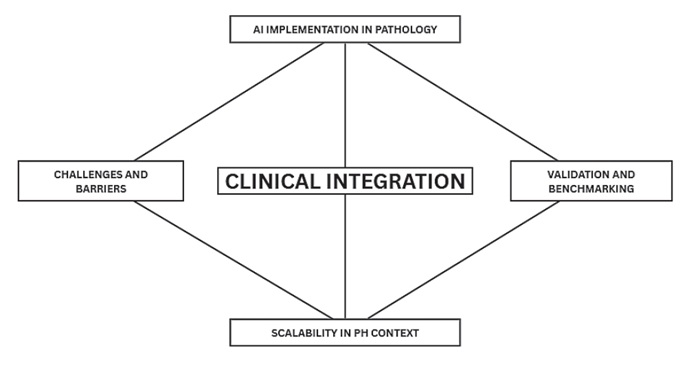
Artificial Intelligence (AI) is transforming the landscape of pathology, particularly in resource-constrained settings like the Philippines. This narrative review explores the applications, challenges, and future potential of AI in digital image analysis for pathology practices. By synthesizing peer-reviewed literature from 2019 to 2024, the review highlights the role of machine learning (ML) and deep learning (DL) algorithms in enhancing diagnostic accuracy, workflow efficiency, and clinical decision-making. AI-driven tools such as convolutional neural networks (CNNs) and transfer learning models have demonstrated significant success in tumor detection, biomarker evaluation, and predictive analytics, paving the way for personalized medicine. However, barriers such as limited annotated datasets, privacy concerns, and model interpretability hinder widespread adoption. The review emphasizes the need for ethical frameworks, workforce training, and infrastructure development to ensure equitable and effective integration of AI into pathology practices. By addressing these challenges, AI has the potential to improve diagnostic precision, expand access to healthcare, and modernize pathology services in the Philippines.
Downloads
References
Cocuz IG, Niculescu R, Popelea MC, et al. Current trends and future directions of digital pathology and artificial intelligence in dermatopathology: a scientometric-based review. Diagnostics (Basel). 2025;15(17):2196. https://pubmed.ncbi.nlm.nih.gov/40941682 https://pmc.ncbi.nlm.nih.gov/articles/PMC12428701 https://doi.org/10.3390/diagnostics15172196
Bustamante-Arias A, Cheddad A, Jiménez-Pérez J, Rodríguez-García A. Digital image processing and development of machine learning models for the discrimination of corneal pathology: an experimental model. Photonics. 2021;8(4):118. https://doi.org/10.3390/photonics8040118
Mayer C, Ofek E, Fridrich DE, et al. Direct identification of ALK and ROS1 fusions in non-small cell lung cancer from hematoxylin and eosin-stained slides using deep learning algorithms. Mod Pathol. 2022;35(12):1882-7. https://doi.org/10.1038/s41379-022-01141-4
Wuzhao R, Gong G, Cao S, et al. Research on image classification of pathology based on deep learning. J Intell Knowl Eng. 2024;2(1):76. https://doi.org/10.62517/jike.202404111
Cao R, Yang F, Ma SC, et al. Development and interpretation of a pathomics-based model for the prediction of microsatellite instability in colorectal cancer. Theranostics. 2020;10(24):11080-91. https://pubmed.ncbi.nlm.nih.gov/33042271 https://pmc.ncbi.nlm.nih.gov/articles/PMC7532670 https://doi.org/10.7150/thno.49864
Lim A, Natarajan P, Fonseka R, Maharaj M, Mobbs RJ. Application of artificial intelligence and custom algorithms with inertial wearable devices for gait analysis and detection of gait-altering pathologies in adults: a scoping review. Digit Health. 2022;8:205520762210741. https://pubmed.ncbi.nlm.nih.gov/35111331 https://pmc.ncbi.nlm.nih.gov/articles/PMC8801637 https://doi.org/10.1177/20552076221074128
Basso MN, Barua M, Meyer J, John R, Khademi A. Machine learning in renal pathology. Front Nephrol. 2022;2:1007002. https://pubmed.ncbi.nlm.nih.gov/37675000 https://pmc.ncbi.nlm.nih.gov/articles/PMC10479587 https://doi.org/10.3389/fneph.2022.1007002
Uchino E, Suzuki K, Sato N, et al. Classification of glomerular pathological findings using deep learning and nephrologist–AI collective intelligence approach. Int J Med Inform. 2020;141:104231. https://pubmed.ncbi.nlm.nih.gov/32682317 https://doi.org/10.1016/j.ijmedinf.2020.104231
Verde L, Pietro G, Sannino G. Artificial intelligence techniques for non-invasive detection of COVID-19 through the analysis of voice signals. Arab J Sci Eng. 2021;48:1-11. https://pubmed.ncbi.nlm.nih.gov/34642613 https://pmc.ncbi.nlm.nih.gov/articles/PMC8500467 https://doi.org/10.1007/s13369-021-06041-4
Xie Y, Zaccagna F, Rundo L, et al. Convolutional neural network techniques for brain tumor classification (from 2015 to 2022): review, challenges, and future perspectives. Diagnostics (Basel). 2022;12(8):1850. https://pubmed.ncbi.nlm.nih.gov/36010200 https://pmc.ncbi.nlm.nih.gov/articles/PMC9406354 https://doi.org/10.3390/diagnostics12081850
Huang Z, Johnson T, Han Z, et al. Deep learning–based cancer survival prognosis from RNA-seq data: approaches and evaluations. BMC Med Genomics. 2020;13(Suppl 5). https://pubmed.ncbi.nlm.nih.gov/32241264 https://pmc.ncbi.nlm.nih.gov/articles/PMC7118823 https://doi.org/10.1186/s12920-020-0686-1
Wu Q, Ding Q, Lin W, et al. Profiling of tumor cell–delivered exosome by surface enhanced raman spectroscopy-based biosensor for evaluation of nasopharyngeal cancer radioresistance. Adv Healthc Mater. 2023;12(8):e2202482. https://pubmed.ncbi.nlm.nih.gov/36528342 https://doi.org/10.1002/adhm.202202482
Thorat M, Kahane S, Newase A, Jadhao O, Ghuge C. Automated brain tumor detection using deep learning and flask web application. Asian J Converg Technol. 2024;10(1):69-73. https://doi.org/10.33130/ajct.2024v10i01.014
Alam NA, Ahsan M, Based M, Haider J, Kowalski M. COVID-19 detection from chest X-ray images using feature fusion and deep learning. Sensors (Basel). 2021;21(4):1480. https://pubmed.ncbi.nlm.nih.gov/33672585 https://pmc.ncbi.nlm.nih.gov/articles/PMC8078171 https://doi.org/hg10.3390/s21041480
Li A, Li X, Li W, Yu X, Qi M, Ding L. Application of deep learning on the prognosis of cutaneous melanoma based on full-scan pathology images. Biomed Res Int. 2022;2022:4864485. https://pubmed.ncbi.nlm.nih.gov/36072469 https://pmc.ncbi.nlm.nih.gov/articles/PMC9441353 https://doi.org/10.1155/2022/4864485
Elton DC, Türkbey EB, Pickhardt PJ, Summers RM. A deep learning system for automated kidney stone detection and volumetric segmentation on noncontrast CT scans. Med Phys. 2022;49(4):2545-54. https://pubmed.ncbi.nlm.nih.gov/ 35156216 https://pmc.ncbi.nlm.nih.gov/articles/PMC10407943 https://doi.org/10.1002/mp.15518
Navarro F, Dapper H, Asadpour R, et al. Development and external validation of deep-learning-based tumor grading models in soft-tissue sarcoma using MR imaging. Cancers (Basel). 2021;13(12):2866. https://pubmed.ncbi.nlm.nih.gov/34201251 https://pmc.ncbi.nlm.nih.gov/articles/PMC8227009 https://doi.org/10.3390/cancers13122866
Chieregato M, Frangiamore F, Morassi M, et al. A hybrid machine learning/deep learnning COVID-19 severity predictive model from CT images and clinical data. Sci Rep. 2022;12(1):4329. https://doi.org/10.1038/s41598-022-07890-1
Mishra P, Panda A, Mahapatra M, Dakshinakabat P, Mohanty A, Bhuyan L. Application and fallibility of AI and ML in diagnostic pathology. Bangladesh J Med Sci. 2024;S32-7. https://doi.org/10.3329/bjms.v23i10.71732
Hameed BM, Dhavileswarapu AVLS, Raza SZ, et al. Artificial intelligence and its impact on urological diseases and management: a comprehensive review. J Clin Med. 2021;10(9):1864. https://pubmed.ncbi.nlm.nih.gov/33925767 https://pmc.ncbi.nlm.nih.gov/articles/PMC8123407 https://doi.org/10.3390/jcm10091864
Sun Z, Wu P, Cui Y, et al. Deep-learning models for detection and localization of visible clinically significant prostate cancer on multi-parametric MRI. J Magn Reson Imaging. 2023;58(4):1067-81. https://pubmed.ncbi.nlm.nih.gov/36825823 https://doi.org/10.1002/jmri.28608
Nwankwo EI, Emeihe EV, Ajegbile MD, Olaboye JA, Maha CC. AI in personalized medicine: enhancing drug efficacy and reducing adverse effects. Int Med Sci Res J. 2024;4(8):806-33. https://doi.org/10.51594/imsrj.v4i8.1453
Kartasalo K, Bulten W, Delahunt B, et al. Artificial intelligence for diagnosis and Gleason grading of prostate cancer in biopsies - current status and next steps. Eur Urol Focus. 2021;7(4):687-91. https://doi.org/10.1016/j.euf.2021.07.002
Li S, Wang KX, Li JL, et al. AI-predicted mpMRI image features for the prediction of clinically significant prostate cancer. Int Urol Nephrol. 2023;55(11):2703-15. https://doi.org/10.1007/s11255-023-03722-x
Trabelsi M, Romdhane H, Ben-Salem L, Ben-Sellem D. Advanced artificial intelligence framework for T classification of TNM lung cancer in 18FDG-PET/CT imaging. Biomed Phys Eng Express. 2024;10(6):065037. https://doi.org/10.1088/2057-1976/ad81ff
Han Z. The application and challenges of artificial intelligence in brain tumor recognition. Appl Comput Eng. 2023;17(1):17-22. https://doi.org/10.54254/2755-2721/17/20230904
van der Kamp A, de Bel T, van Alst L, et al. Automated deep learning-based classification of Wilms tumor histopathology. Cancers (Basel). 2023;15(9):2656. https://pubmed.ncbi.nlm.nih.gov/37174121 https://pmc.ncbi.nlm.nih.gov/articles/PMC10177041 https://doi.org/10.3390/cancers15092656
Ramírez JGC. AI in healthcare: revolutionizing patient care with predictive analytics and decision support systems. J Artif Intell Gen Sci. 2024;1(1):31-7. https://doi.org/10.60087/jaigs.v1i1.p37
Huang J, Xing Y Gan S, et al. Application of artificial intelligence in medical imaging for tumor diagnosis and treatment: a comprehensive approach. Discov Onc. 2025; 16:1625. https://doi.org/10.1007/s12672-025-03307-3
Keim-Malpass J, Moorman L, Monfredi O, Clark M, Bourque J. Off-target uses of artificial intelligence-based predictive analytics in learning health system. Learn Health Syst. 2022;7(1):e10323. https://pubmed.ncbi.nlm.nih.gov/36654806 PMCID: PMC9835046 https://doi.org/10.1002/lrh2.10323
Shuford J. AI in healthcare: transforming patient care through predictive analytics and decision support systems. J Artif Intell Gen Sci. 2024;1(1):5-10. https://doi.org/10.60087/jaigs.v1i1.p30
Zhu L, Gao G, Zhu Y, et al. Fully automated detection and localization of clinically significant prostate cancer on MR images using a cascaded convolutional neural network. 2022;12. https://doi.org/10.3389/fonc.2022.958065
Kim J, Bae S, Yoon S, Jeong S. Roadmap for providing and leveraging annotated data by cytologists in the PDAC domain as open data: support for AI-based pathology image analysis development and data utilization strategies. Front Oncol. 2024;14:1346237. https://pubmed.ncbi.nlm.nih.gov/39035745 https://pmc.ncbi.nlm.nih.gov/articles/PMC11258423 https://doi.org/10.3389/fonc.2024.1346237
Jiang Y, Sui X, Ding Y, Xiao W, Zheng Y, Zhang Y. Semi-supervised learning approachwith consistency regularization for tumor histopathology analysis. Front Oncol. 2023;12:1044026. https://pubmed.ncbi.nlm.nih.gov/36698401 https://pmc.ncbi.nlm.nih.gov/articles/PMC9870542 https://doi.org/10.3389/fonc.2022.1044026
Selnes O, Bjørsum-Meyer T, Histace A, Baatrup G, Koulaouzidis A. Annotation tools in gastrointestinal polyp annotation. Diagnostics (Basel). 2022;12(10):2324. https://pubmed.ncbi.nlm.nih.gov/36292013 https://pmc.ncbi.nlm.nih.gov/articles/PMC9600922 https://doi.org/10.3390/diagnostics12102324
Petry M, Lansky C, Chodakiewitz Y, Maya M, Pressman B. Decreased length of stay for ICH and PE after adoption of an artificial intelligence-augmented radiological worklist triage system. Radiol Res Pract. 2022;2022:2141839. https://pubmed.ncbi.nlm.nih.gov/36034496 https://pmc.ncbi.nlm.nih.gov/articles/PMC9411003 https://doi.org/10.1155/2022/2141839
Kotovich D, Twig G, Itsekson-Hayosh Z, et al. Impact on clinical outcomes after 1 year of implementation of an artificial intelligence solution the detection of intracranial hemorrhage. Int J Emerg Med. 2023;16(1):50. https://pubmed.ncbi.nlm.nih.gov/37568103 https://pmc.ncbi.nlm.nih.gov/articles/PMC10422703 https://doi.org/10.1186/s12245-023-00523-y
Switzer D, Knowles S. Ethics: crisis standards of care simulation. Adv Emerg Nurs J. 2024;46(1):71-81. https://pubmed.ncbi.nlm.nih.gov/38285425 https://doi.org/10.1097/TME.0000000000000498
Adebayo O, Bhuiyan Z, Ahmed Z. Effectiveness of AI, ML and DL in trauma triage: systematic review. Digital Health. 2023;9:20552076231205736. https://pubmed.ncbi.nlm.nih.gov/37822960 https://pmc.ncbi.nlm.nih.gov/articles/PMC10563501 https://doi.org/10.1177/20552076231205736
Habbouche S, Carlson T, Johansson D, et al. Comparison of the novel WEst coast System for Triage (WEST) with Rapid Emergency Triage and Treatment System (RETTS©): an observational pilot study. Int Emerg Med.2022;15(1):47. https://pubmed.ncbi.nlm.nih.gov/36096726 https://pmc.ncbi.nlm.nih.gov/articles/PMC9465908 https://doi.org/10.1186/s12245-022-00452-2
Eloy C, Vale J, Curado M, et al. Digital pathology workflow implementation at IPATIMUP. Diagnostics (Basel). 2021;11(11):2111. https://pubmed.ncbi.nlm.nih.gov/34829458 https://pmc.ncbi.nlm.nih.gov/articles/PMC8620597 https://doi.org/10.3390/diagnostics11112111
Berbís M, McClintock D, Bychkov A, et al. The future of computational pathology: expectations regarding the anticipated role of artificial intelligence in pathology by 2030. medRxiv. 2022. https://doi.org/10.1101/2022.09.02.22279476
Montezuma D, Monteiro A, Fraga J, et al. Digital pathology implementation: specific challenges and opportunities. Diagnostics (Basel). 2022;12(2):529. https://pubmed.ncbi.nlm.nih.gov/35204617 https://pmc.ncbi.nlm.nih.gov/articles/PMC8871027 DOI: 10.3390/diagnostics12020529
Dow E, Khan N, Chen K, et al. AI-human hybrid workflow enhances teleophthalmology for the detection of diabetic retinopathy. Ophthalmol Sci. 2023;3(4):100330. https://pubmed.ncbi.nlm.nih.gov/37449051 https://pmc.ncbi.nlm.nih.gov/articles/PMC10336195 DOI: 10.1016/j.xops.2023.100330
Hanna M, Reuter V, Ardon O, et al. Validation of a digital pathology system including remote review during the COVID-19 pandemic. Mod Pathol. 2020;33(11):2115-27. https://pubmed.ncbi.nlm.nih.gov/32572154 https://pmc.ncbi.nlm.nih.gov/articles/PMC7306935 https://doi.org/10.1038/s41379-020-0601-5
Zarella MD, Bowman D, Aeffner F, et al. Practical guide to whole slide imaging. J Pathol Inform. 2023;143(2):222-34. https://pubmed.ncbi.nlm.nih.gov/30307746 https://doi.org/10.5858/arpa.2018-0343-RA
Huo X, Ong KH, Lau KW, et al. A comprehensive AI model development framework for consistent Gleason grading. Commun Med. 2024;4:84. https://doi.org/10.1038/s43856-024-00502-1
Jorg T, Halfmann M, Stoehr F, et al. A novel reporting workflow for automated integration of artificial intelligence. Insights Imaging. 2024;15:80. https://doi.org/10.1186/s13244-024-01660-5
Yao J, Chu L, Patlas M. Applications of AI in acute abdominal imaging. Can Assoc Radiol J. 2024;75(4):761-70. https://doi.org/10.1177/08465371241250197
Andreychenko AE, Logunova TA, Gombolevskiy VA, et al. Methodology for selection and quality control of the radiological computer vision deployment at the megalopolis scale. medRxiv. 2022. https://doi.org/10.1101/2022.02.12.22270663
Chatrian A, Colling R, Browning L, et al. Artificial intelligence for advance requesting of immunohistochemistry in diagnostically uncertain prostate biopsies. Mod Pathol. 2021;34(9):1780-94. https://doi.org/10.1038/s41379-021-00826-6
McGenity C, Clarke EL, Jennings C, et al. AI in digital pathology: systematic review and meta-analysis of diagnostic accuracy. npj Digit Med. 2024;7:114. https://doi.org/10.1038/s41746-024-01106-8
Talo M. Automated classification of histopathology images using transfer learning. arXiv. 2019. https://arxiv.org/abs/1903.10035
Alom MZ, Aspiras T, Taha TM, et al. Advanced deep convolutional neural network approaches for digital pathology image analysis: a comprehensive evaluation with different use cases.. arXiv. 2019. https://arxiv.org/abs/1904.09075
Vorontsov E, Bozkurt A, Casson A, et al. Virchow: A million-slide digital pathology foundation model. arXiv. 2023. https://arxiv.org/abs/2309.07778
Allen J. Diagnostics World – comparison of AI digital pathology tools finds means to measure performance. Friends of Cancer Research. May 13, 2025. https://friendsofcancerresearch.org/news/diagnostics-world-comparison-of-ai-digital-pathology-tools-finds-means-to-measure-performance/
Downloads
Published
How to Cite
Issue
Section
License
Copyright (c) 2025 Marco Jay Beralde

This work is licensed under a Creative Commons Attribution-NonCommercial-ShareAlike 4.0 International License.






 Educational mini-series for authors, reviewers, pathology residents, and researchers dedicated to improving scientific writing in pathology and laboratory medicine.


 @philippinepathologyjournal